


072 & 073
Residences at Changanassery
Location: Changanssery, Kerala
Type: Residence
Status: Ongoing
Area: 5000 sqft (combined)
Client: Tom Joseph, Jose Joseph
Collaborator(s): Reform Constructions, Jose Michael
Design Team:
Madhushitha CA, Lijo John Mathew, Reshma Mathew, Nandagopal M
The residences at Changanacherry began as a single landscape insert for the already existing residence of Mr Mathew Joseph. The house that sat on an elevated site was almost 8 feet above the street level, in turn disengaging it from the collective infrastructure of the neighbourhood. The first architectural operation was to navigate this height and modulate it as a series of courts, sunken and elevated, navigating different degrees of privacy and enclosure. We take inspiration from Geoffrey Bawa’s whimsical spaces within his Lunagunga estate becoming an elaborate labyrinth of thresholds between the site and the built form.
A quarter circle in the form of a ramp was introduced to gradually approach the house from the street and the circle inscribed in gridded garden courts with wild, non-manicured vegetation within. The density of the tropical plants and trees filter the light, creating dappled patterns of light and shadow on the ground. This is contrasted with dressed stone masonry used for steps, floors and walls. The material palette gives the landscape the imagery of being a place carved out from the ground. Over time, the growth of the plants gradually covers the brutal surfaces of the stone and concrete and enhances the patina of time. Whimsical sculptures of clay animals are introduced into the garden at hidden corners.
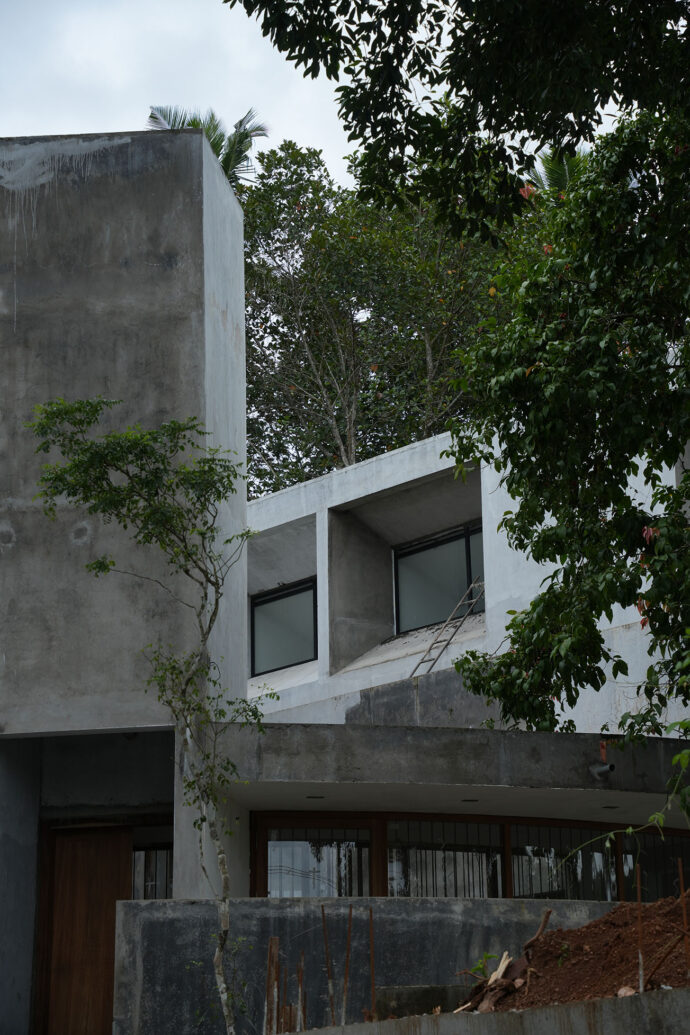
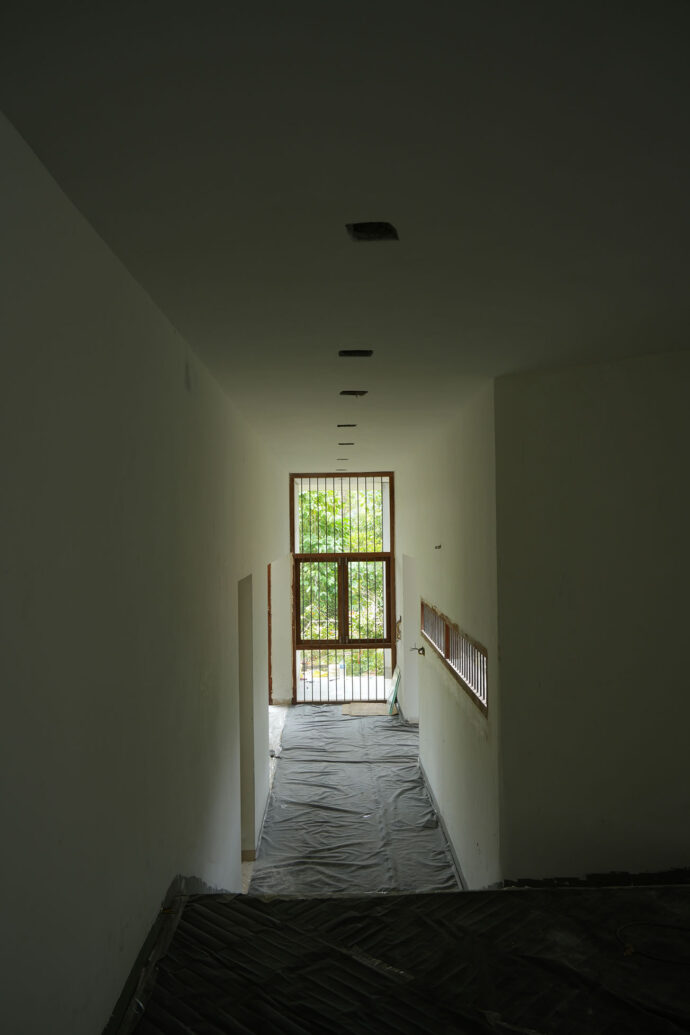
Later this project grew into two other separate houses to be built for the brothers of Mathew Joseph, subdividing the ancestral land and replacing the family home currently sitting on a parcel of the whole site. For the youngest son, the footprint of the original house became the point of origin. The same footprint of the original house, three rooms in a row, became the primary family space for the youngest son’s house. The centre point of this rectangle was used to draw a large circle, inscribing all the spaces of the house within it. Both the houses, Tom House and Jose House, are built by retaining the existing site levels. As a result, in Jose House the parking spaces for the cars are provided on the lower level, in proximity to the street and then the house is approached by a series of steps or a more ceremonial ramp through the landscape. In Tom House, a ramp leads up from the street to the entrance of the house on the first level which directs one to a linear corridor sitting on two levels.
Owing to the emotional significance and memory associated with the site, the existing path connecting the kitchens of Mathew’s house and the family house was retained. This becomes the activated social space for all three houses now, with all the kitchen and family spaces opening into this. The two new houses are also connected with a square, open court meant for everyday domestic activities and containing the existing rose apple tree within it. Steep sloping roofs define the volumes letting in adequate light through clerestory windows. The deflected lights bathes the ceiling and enhances the double height volumes in the rooms. The remaining spaces within the circle of Tom House become garden courts and the inside of the ramp in Jose House becomes the primary landscape there. All bedrooms and living rooms in both houses open either into a verandah or a planter bed. All habitable spaces thus look out into garden areas. The datum of the corridor, the central axis in both houses are emphasised formally as a flat roofed, linear rectangular block connecting the front of the house to the untamed vegetation at the rear.